
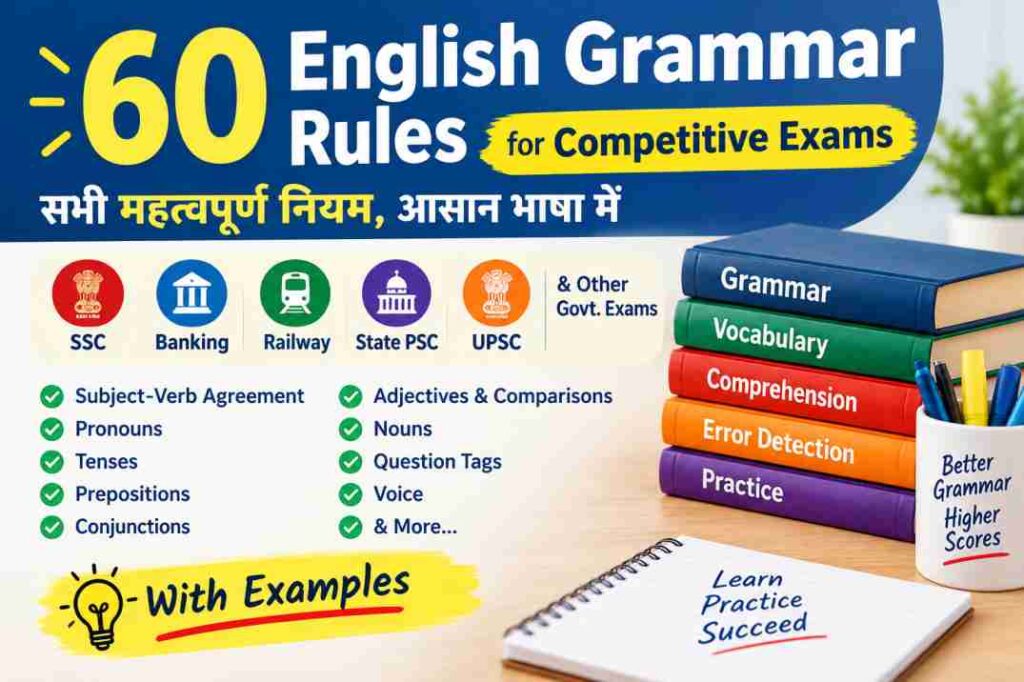
This article is is structured for competitive examination preparation, including SSC, Banking, Railway, State PSC, UPSC-related English tests and other government recruitment examinations.
Introduction: Learn English Grammar Smartly
English grammar is an important part of competitive examinations in India. Questions on error detection, sentence correction, fill in the blanks, pronouns, tenses, subject-verb agreement and prepositions frequently test a candidate’s understanding of grammatical principles.
The most effective strategy is to understand the basic rules rather than memorise hundreds of isolated sentences. Once you identify the part of speech, the actual subject and the structure of a sentence, many grammatical errors become easier to detect.
This guide explains 60 important English grammar rules with incorrect and correct examples, examination tips and practical explanations. The rules are organised into six major categories for systematic revision.
Quick navigation
- Rules 1–10: Pronouns and question tags
- Rules 11–20: Nouns and subject-verb agreement
- Rules 21–30: Advanced subject-verb agreement
- Rules 31–40: Adjectives, comparisons and pronouns
- Rules 41–50: Tenses and sentence construction
- Rules 51–60: Conjunctions, prepositions and voice
- Practice questions
Rules 1–10: Pronouns and Question Tags
Rule 1: Identify indefinite pronouns
Words such as everybody, somebody, anybody, nobody, everything, something, anything and nothing are indefinite pronouns.
They refer to people or things without identifying a specific individual or object.
Examples:
- Incorrect: Everybody are present.
- Correct: Everybody is present.
Exam tip: Identify the pronoun before selecting the verb.
Rule 2: Indefinite pronouns generally take singular verbs
In conventional examination grammar, everybody, somebody, anybody and nobody take singular verbs.
- Incorrect: Everybody are ready.
- Correct: Everybody is ready.
- Incorrect: Nobody have arrived.
- Correct: Nobody has arrived.
Remember the common combinations: everybody is, somebody has, nobody does.
Rule 3: Possessive pronouns and adjectives
Traditional examination grammar often pairs indefinite pronouns with singular possessive forms such as his or her.
– Traditional exam-style example: Everybody should complete his work.
In contemporary English, singular their is also widely accepted and is often the most natural choice when gender is unknown.
– Modern example: Everybody should complete their work.
Exam tip: Follow the conventions specified by the examination or question context. Do not assume that singular they is always incorrect in modern English.
Rule 4: Maintain pronoun agreement
A pronoun should refer clearly to its antecedent, the word or expression it replaces.
- Traditional exam-style example: Anybody can succeed if he works hard.
- Contemporary alternative: Anybody can succeed if they work hard.
The sentence must remain clear and grammatically consistent.
Rule 5: Understand the use of “but”
The word but can function as a conjunction or a preposition.
- Conjunction: He is poor, but he is honest.
- Preposition meaning “except”: Nobody but Ravi knew the answer.
When but means “except,” the verb agrees with the actual subject, not the noun following but.
Example:
- Incorrect: Nothing but books were available.
- Correct: Nothing but books was available.
Rule 6: Match the pronoun with the meaning
Use pronouns that logically refer to the intended people or things.
- Incorrect: Nothing but some students was present.
- Correct: Nobody but some students was present.
Here, nobody refers to people, while nothing refers to things.
Rule 7: Distinguish “everyone” from “every”
Everyone is a pronoun, whereas every is a determiner used before a singular countable noun.
- Incorrect: Everyone section of the society is affected.
- Correct: Every section of the society is affected.
Other examples:
- Every student must attend the class.
- Everyone must attend the class.
Rule 8: Question tags with indefinite pronouns referring to people
A question tag normally uses an auxiliary verb and a pronoun that refers back to the subject.
In traditional competitive-exam patterns, indefinite pronouns referring to people often use they in the question tag.
- Example: Somebody was present, weren’t they?
- Example: Everybody has arrived, haven’t they?
Although the main clause uses a singular verb, the tag commonly uses singular they with a plural-form auxiliary.
Rule 9: Question tags after negative statements
A negative statement generally takes a positive question tag.
- Incorrect: Nobody was present, weren’t they?
- Correct: Nobody was present, were they?
Other examples:
- Nothing happened, did it?
- Nobody knows the answer, do they?
Rule 10: Question tags for things
When the subject is an indefinite pronoun referring to a thing, use it in the question tag.
- Incorrect: Nothing was available, were they?
- Correct: Nothing was available, was it?
Similarly:
- Everything is ready, isn’t it?
- Something happened, didn’t it?
Rules 11–20: Nouns and Subject-Verb Agreement
Rule 11: Distinguish person-related and thing-related pronouns
Pronouns ending in -body and -one generally refer to people, while those ending in -thing refer to things.
| People | Things |
| Everybody | Everything |
| Somebody | Something |
| Anybody | Anything |
| Nobody | Nothing |
Example:
- Incorrect: Everything were clear to the students.
- Correct: Everything was clear to the students.
Rule 12: Find the real subject of the sentence
A noun inside a prepositional phrase does not automatically determine the verb.
- Incorrect: The quality of these mangoes are poor.
- Correct: The quality of these mangoes is poor.
The subject is quality, not mangoes.
Exam tip: Temporarily ignore phrases beginning with of, with, along with and similar prepositions to identify the main subject.
Rule 13: Collective nouns used as a unit
Collective nouns include team, committee, jury, family and government.
When the group acts as a single unit, singular agreement is common, especially in American English and formal exam questions.
- Incorrect: The committee have submitted its report.
- Correct: The committee has submitted its report.
British English may use plural agreement when the members are viewed individually.
Rule 14: Collective nouns expressing individual differences
When members of a group act separately or disagree, plural agreement may be appropriate, particularly in British English.
– Example: The jury were divided in their opinions.
In American English, a sentence such as “The jury members were divided in their opinions” is also clear and natural.
Exam tip: Consider whether the group is acting as one unit or as individual members.
Rule 15: Nouns that are plural in form
Words such as scissors, trousers, spectacles and pliers generally take plural verbs.
- Incorrect: My spectacles is missing.
- Correct: My spectacles are missing.
However, when referring to one item as a unit, use a pair of with a singular verb.
– A pair of spectacles is on the table.
Rule 16: Nouns ending in “-s” but treated as singular
Some academic subjects and other nouns are singular despite ending in -s.
Examples include mathematics, physics, economics and news.
- Incorrect: Mathematics are difficult.
- Correct: Mathematics is difficult.
- Incorrect: The news are good.
- Correct: The news is good.
Rule 17: Academic subjects versus skills
The word mathematics normally takes a singular verb when it refers to the academic subject.
– Correct: His mathematics is excellent.
When referring to calculation skills, use a plural expression such as mathematical skills.
– Correct: His mathematical skills are excellent.
Exam tip: Do not automatically change the verb merely because the subject has a possessive modifier such as his or her.
Rule 18: Plural nouns without “-s”
Some nouns are plural in meaning without ending in -s.
Examples include cattle, people, police and poultry when referring to the animals collectively.
- Incorrect: The cattle is grazing.
- Correct: The cattle are grazing.
- Incorrect: The police has arrived.
- Correct: The police have arrived.
Use a person or an individual for one human being, rather than treating people as a normal singular noun.
Rule 19: Uncountable nouns
Words such as furniture, advice, information, luggage and equipment are generally uncountable.
- Incorrect: The furnitures were damaged.
- Correct: The furniture was damaged.
- Incorrect: She gave me many advices.
- Correct: She gave me a lot of advice.
To count these items, use expressions such as pieces of advice or items of furniture.
Rule 20: Compound adjectives expressing measurement
When a number and a unit form a compound adjective before a noun, the unit generally remains singular.
- Incorrect: He bought a five-rupees note.
- Correct: He bought a five-rupee note.
- Incorrect: It is a ten-kilometres journey.
- Correct: It is a ten-kilometre journey.
Compare:
- The journey is ten kilometres long.
- It is a ten-kilometre journey.
Rules 21–30: Advanced Subject-Verb Agreement
Rule 21: Either…or and neither…nor
When two subjects are joined by either…or or neither…nor, the verb generally agrees with the subject closest to it.
- Incorrect: Neither the teacher nor the students was present.
- Correct: Neither the teacher nor the students were present.
- Correct: Neither the students nor the teacher was present.
Rule 22: “Along with”, “as well as” and “together with”
These expressions do not normally make the main subject plural.
- Incorrect: The captain, along with the crew members, were present.
- Correct: The captain, along with the crew members, was present.
More examples:
- The manager as well as the employees is responsible.
- The principal, together with the teachers, has arrived.
Rule 23: Agreement with relative pronouns
The verb in a relative clause agrees with the antecedent of who, which or that.
- Incorrect: It is I who is responsible.
- Correct: It is I who am responsible.
Another example:
– She is one of the employees who work hard.
The relative pronoun who refers to employees, so the verb is plural.
Rule 24: “One of” followed by a plural noun
The structure is generally:
One of + plural noun + singular verb
- Incorrect: One of my friend are coming.
- Correct: One of my friends is coming.
More examples:
- One of the candidates has qualified.
- One of these books belongs to me.
Rule 25: “One of those…who”
When who refers to the plural noun following one of those, the verb in the relative clause is plural.
- Incorrect: He is one of those men who does not lie.
- Correct: He is one of those men who do not lie.
The relative clause describes the men, not just one individual.
Rule 26: “The only one of those…who”
When the construction identifies the only individual possessing a quality, the relative clause normally takes a singular verb.
- Incorrect: This is the only one of his books that are worth reading.
- Correct: This is the only one of his books that is worth reading.
Compare:
- He is one of the players who have scored.
- He is the only one of the players who has scored.
Rule 27: Each and every
Each and every normally take a singular countable noun and a singular verb.
- Incorrect: Each students have received a certificate.
- Correct: Each student has received a certificate.
- Incorrect: Every employee are responsible.
- Correct: Every employee is responsible.
Rule 28: “Every” used with two nouns
When two singular nouns are joined using the structure every… and every…, the subject is generally treated as singular.
- Incorrect: Every boy and every girl were invited.
- Correct: Every boy and every girl was invited.
Rule 29: “Many a” and “many an”
The expressions many a and many an are followed by a singular countable noun and a singular verb.
- Incorrect: Many a students have failed.
- Correct: Many a student has failed.
Compare:
- Many students have failed.
- Many a student has failed.
Rule 30: “A number of” versus “the number of”
This is a frequently tested distinction.
| Expression | Verb | Example |
| A number of + plural noun | Plural | A number of applicants are waiting. |
| The number of + plural noun | Singular | The number of applicants is increasing. |
Exam tip: “A number of” means several; “the number of” refers to a particular total.
Rules 31–40: Adjectives, Comparisons and Pronouns
Rule 31: Less versus fewer
Use fewer with countable plural nouns and less with uncountable quantities.
- Incorrect: Less candidates attended the interview.
- Correct: Fewer candidates attended the interview.
- Incorrect: Fewer water is required.
- Correct: Less water is required.
Rule 32: Little, a little and the little
These expressions have different meanings.
| Expression | Meaning | Example |
| Little | Almost none; negative sense | He has little hope of success. |
| A little | Some; positive sense | He has a little experience. |
| The little | All of a small amount | The little money he had was spent. |
Rule 33: Few, a few and the few
These expressions are used with countable plural nouns.
| Expression | Meaning | Example |
| Few | Almost none | Few candidates qualified. |
| A few | Some | A few candidates qualified. |
| The few | All of a limited number | The few friends he had supported him. |
Rule 34: Avoid double comparatives
Do not normally combine more with an adjective already in its comparative form.
- Incorrect: She is more cleverer than her sister.
- Correct: She is cleverer than her sister.
- Also correct: She is more intelligent than her sister.
Rule 35: Avoid double superlatives
Do not combine most with an adjective already in its superlative form.
- Incorrect: He is the most best player.
- Correct: He is the best player.
- Incorrect: She is the most tallest girl.
- Correct: She is the tallest girl.
Rule 36: Adjectives ending in “-ior”
Adjectives such as superior, inferior, senior, junior and prior are traditionally followed by to rather than than.
- Incorrect: He is senior than me.
- Correct: He is senior to me.
- Incorrect: This product is superior than that one.
- Correct: This product is superior to that one.
Rule 37: Order of personal pronouns in affirmative statements
A traditional examination convention recommends the order second person → third person → first person in ordinary affirmative statements.
– Traditional pattern: You, he and I will attend the meeting.
This is a convention taught in many grammar examinations rather than an absolute rule governing every natural English sentence.
Rule 38: Pronoun order when admitting fault
Traditional grammar lessons often recommend putting the first-person pronoun first when admitting responsibility.
– Example: I, you and he made the mistake.
The key objective is to make responsibility clear and the sentence natural. Pronoun order may vary with emphasis and context.
Rule 39: Pronouns after “than” and “as”
In formal comparisons, a subject pronoun may be used when an entire clause is understood.
- Example: He runs faster than I do.
- Example: She is as tall as he is.
In everyday English, object forms such as me and him are also common where the remaining clause is omitted.
– Example: He is taller than me.
Exam tip: In formal error-detection questions, check whether the comparison requires a subject or object pronoun.
Rule 40: Pronouns after prepositions and “let”
Prepositions normally take object pronouns.
- Incorrect: Between you and I, this is difficult.
- Correct: Between you and me, this is difficult.
The verb let is also followed by an object pronoun.
- Incorrect: Let you and I do this work.
- Correct: Let you and me do this work.
Other examples: for him, with her, between us, among them.
Rules 41–50: Tenses and Sentence Construction
Rule 41: Present perfect versus simple past
Use the simple past when referring to a completed action at a definite past time.
- Incorrect: I have seen him yesterday.
- Correct: I saw him yesterday.
- Incorrect: She has completed the work last week.
- Correct: She completed the work last week.
Present perfect is generally used when the time is unspecified or the past action has a present connection.
Rule 42: Earlier and later actions in the past
The past perfect (had + past participle) can indicate which of two past actions happened first.
– Example: The train had left before I reached the station.
However, the simple past can also be correct when the sequence is already clear.
– Example: The train left before I reached the station.
Exam tip: Use the past perfect when the earlier action needs to be emphasised or clarified; do not assume it is mandatory in every sentence containing two past actions.
Rule 43: Zero conditional and general truths
Use the simple present in both clauses when describing general truths or scientific facts.
- Incorrect: If you will heat ice, it melts.
- Correct: If you heat ice, it melts.
Another example:
– If water reaches its boiling point under the stated conditions, it boils.
Rule 44: First conditional
For a real or possible future condition, use the simple present in the if-clause and a suitable future expression in the main clause.
- Incorrect: If it will rain, we will cancel the match.
- Correct: If it rains, we will cancel the match.
Pattern: If + simple present, will + base verb.
Rule 45: Second conditional
Use the second conditional for hypothetical or unlikely present or future situations.
- Incorrect: If I was a king, I will help the poor.
- Formal exam-style correction: If I were a king, I would help the poor.
Pattern: If + past form, would + base verb.
In hypothetical formal English, were is traditionally used with all subjects, especially in the expression if I were.
Rule 46: Third conditional
The third conditional describes an unreal past condition and its imagined result.
- Incorrect: If he worked hard, he would have passed.
- Correct: If he had worked hard, he would have passed.
Pattern: If + had + past participle, would have + past participle.
Rule 47: Stative verbs
Stative verbs describe conditions, knowledge, emotions, possession or perception. They are not normally used in continuous forms when they retain these meanings.
- Incorrect: I am knowing the answer.
- Correct: I know the answer.
- Incorrect: She is owning a house.
- Correct: She owns a house.
Some verbs can take continuous forms when their meaning changes, such as I am thinking about the problem.
Rule 48: Since versus for
Use since for a starting point and for for a duration.
| Since | For |
| Since 2021 | For five years |
| Since Monday | For three days |
| Since morning | For several hours |
Examples:
- Incorrect: He has been living here since five years.
- Correct: He has been living here for five years.
- Correct: He has been living here since 2021.
Rule 49: “As if” and “as though”
When describing an unreal or hypothetical situation, a past form may be used after as if or as though.
- Example: He talks as if he knew everything.
- Example: She behaves as though she were the owner.
When the statement expresses something believed to be true, the present tense can also be appropriate.
– Example: It looks as if it is going to rain.
Rule 50: Avoid dangling participles
A participial phrase should logically describe the person or thing performing the action.
- Incorrect: Walking in the park, a snake bit him.
- Correct: While he was walking in the park, a snake bit him.
The incorrect sentence appears to suggest that the snake was walking in the park.
Another example:
- Incorrect: Having finished the examination, the answer sheet was submitted.
- Correct: Having finished the examination, the candidate submitted the answer sheet.
Rules 51–60: Conjunctions, Prepositions and Voice
Rule 51: Parallel structure
Items connected by and, or and similar conjunctions should have parallel grammatical structures.
- Incorrect: She likes dancing and to sing.
- Correct: She likes dancing and singing.
Other examples:
- He enjoys reading, writing and travelling.
- The job requires planning, organising and managing.
Rule 52: Too…to
The structure too + adjective/adverb + to + verb often expresses an excessive degree that prevents an action.
- Incorrect: He is too weak that he cannot walk.
- Correct: He is too weak to walk.
An alternative structure is:
– He is so weak that he cannot walk.
Do not mix the two constructions.
Rule 53: Hardly and scarcely
Hardly and scarcely are commonly used with the past perfect or an inverted auxiliary structure and are followed by when in traditional examination patterns.
- Incorrect: Hardly had I arrived than the lights went out.
- Correct: Hardly had I arrived when the lights went out.
Another example:
– Scarcely had the train left when it began to rain.
Rule 54: No sooner…than
The conventional structure is no sooner…than.
- Incorrect: No sooner did I reach when the train left.
- Correct: No sooner did I reach the station than the train left.
Another example:
– No sooner had she arrived than the meeting began.
Rule 55: Lest
Lest means “for fear that” or “to avoid the possibility that.” Traditional competitive-exam grammar commonly tests the structure lest…should.
– Example: Work hard lest you should fail.
Avoid using will mechanically after lest in traditional examination questions. In actual usage, other subjunctive constructions are also possible.
Rule 56: Unless versus until
Unless expresses a condition and generally means “if not.” Until expresses a time limit.
- Unless you work hard, you will not succeed.
- Wait here until I return.
Exam tip: Do not confuse a condition with a time reference. Avoid adding an unnecessary negative when it changes the intended meaning.
Rule 57: Prepositions after transitive verbs
Some verbs take a direct object without an additional preposition.
- Incorrect: We discussed about the matter.
- Correct: We discussed the matter.
- Incorrect: He reached at the station.
- Correct: He reached the station.
- Incorrect: She described about the incident.
- Correct: She described the incident.
However, not every verb follows this pattern. For example, talk about, listen to and refer to correctly require prepositions in their usual constructions.
Rule 58: Die of versus die from
In traditional grammar exercises, die of is commonly used with diseases, while die from is often used for external causes or resulting injuries.
- Traditional exam-style example: He died of cancer.
- Example: The person died from injuries sustained in the accident.
Actual usage overlaps, and both prepositions may occur with several causes of death depending on context.
Rule 59: Preferable to
The adjective preferable is conventionally followed by to, not than. It does not normally require more before it.
- Incorrect: Coffee is more preferable than tea.
- Correct: Coffee is preferable to tea.
Another example:
– This method is preferable to the previous method.
Rule 60: Active and passive infinitives
Choose between active and passive infinitives according to the intended meaning.
- Active infinitive: to + base verb
- Passive infinitive: to be + past participle
Examples:
- We have no time to waste. (Active construction)
- There is no time to be wasted. (Passive construction)
Both sentences can be correct, but they express the idea differently. Select the construction that accurately conveys who performs or receives the action.
Practice Questions for Competitive Exams
Test your understanding of the rules with these sample questions.
Grammar mini-test
0 of 10 answered
1. Everybody ___ required to carry an identity card.
A. are
B. is
C. were
D. have
2. The quality of these products ___ excellent.
A. are
B. were
C. is
D. have
3. Neither the manager nor the employees ___ available.
A. was
B. is
C. were
D. has
4. She has lived here ___ 2022.
A. for
B. since
C. from
D. by
5. If I ___ a king, I would help the poor.
A. am
B. was being
C. were
D. will be
6. We discussed ___ the new proposal.
A. about
B. on
C. the
D. over about
7. No sooner had the bell rung ___ the students left.
A. when
B. then
C. than
D. while
8. Each of the candidates ___ a separate application.
A. have submitted
B. has submitted
C. are submitting
D. were submitted
9. He is senior ___ me.
A. than
B. from
C. to
D. over than
10. I ___ him yesterday.
A. have met
B. had meet
C. met
D. have been meeting
Reset test
How to Prepare English Grammar for Competitive Examinations
For effective preparation, follow this practical study plan:
- Master subject-verb agreement first. Practise indefinite pronouns, collective nouns, each/every, and either…or constructions.
- Revise pronouns and comparison rules. Focus on antecedents, question tags, senior to, preferable to, and less versus fewer.
- Study tenses through examples. Understand the differences between simple past, present perfect, past perfect and conditional sentences.
- Learn conjunctions and prepositions in context. Memorise common structures such as hardly…when, no sooner…than and discuss the matter.
- Practise error detection every day. Identify the subject, verb, pronoun, tense and sentence structure before selecting an answer.
- Maintain a mistake notebook. Record each incorrect answer, its underlying rule and one original example.
Frequently Asked Questions (FAQs)
1. Which English grammar rules are most important for SSC exams?
Subject-verb agreement, pronouns, tenses, articles, prepositions, conjunctions, comparison of adjectives, question tags and sentence correction are useful areas to practise.
2. How can I improve English grammar for Banking and Railway exams?
Study one topic at a time, practise previous-year questions, review explanations and take timed quizzes. Regular revision is more effective than memorising rules without understanding them.
3. How many grammar rules should I learn daily?
A practical target is five to ten rules daily, with examples and practice questions. Revise the rules you studied earlier before moving to new topics.
4. Are all traditional grammar rules applicable to modern English?
Not always. Some competitive-exam conventions simplify actual English usage. Singular they, collective-noun agreement and certain tense constructions can vary with context, dialect and formal style. For examinations, follow the accepted standard of the particular question while learning how English is used in real communication.
5. What is the best way to solve error-detection questions?
Read the complete sentence, identify the main subject and verb, examine pronoun references, check tense consistency, and then inspect prepositions and conjunctions. This systematic approach reduces guesswork.
Conclusion
Understanding grammar is not simply a matter of memorising rules. The real skill is recognising how words function within a sentence and applying the appropriate grammatical principle.
These 60 rules provide a structured revision resource for candidates preparing for SSC, Banking, Railway, PSC and other competitive examinations. Study them category by category, practise the examples, and test yourself regularly.
Remember: Identify the subject, understand the sentence structure, apply the rule and verify the meaning before choosing your answer.
Editorial note: This guide is based on the supplied 60-rule notes, with clarifications where traditional exam conventions differ from broader contemporary English usage. Candidates should consult the relevant examination syllabus and official answer keys when resolving disputed grammar questions.